Friday, April 27, 2012

Chocolate Cake!

n.b. Wait until the cake cools to cut it--or it will fall apart like this. But it's still good.
I used to think making chocolate cake was quite complicated. Turns out, it’s easy-peasy. It’s one of the simplest cakes I’ve made ever made. I used the recipe on the back of the cocoa box—the one I bought because I wanted cocoa after reading Maud Martha (that book is truly the gift that keeps on giving). The cake was yummy—even though I forgot to add vanilla extract! Also, chocolate cake goes wonderfully with strawberries—which I ate with the cake to add a semblance of being healthy. I halved the recipe, but I’m including it here in its entirety (I must say, halving it was maybe the hardest part—thank goodness I learned fractions!)

Hershey’s “Perfectly Chocolate” Chocolate Cake

2 cups of sugar
1 ¾ cups all-purpose flour
¾ cup Hershey’s cocoa
1 ½ tsp. baking powder
1 ½ tsp. baking soda
1 tsp. salt
2 eggs
1 cup of milk
½ cup vegetable oil
2 tsp. vanilla extract
1 cup boiling water

 1. Heat oven to 350ºF. Grease and flour two 9-in. round baking pans.

 2. Combine dry ingredients in large bowl. Add eggs, milk, oil, and vanilla.; beat on medium speed for 2 minutes (I just stirred it with a spoon). Stir in boiling water (batter will be thin). Pour into pans.

 3. Bake for 30 – 35 minutes or until wooden pick inserted in the center comes clean.

 4. Eat it up!

Monday, April 23, 2012

A Hope in the Unseen

There's a book in my lap!
Author: Ron Suskind

Category: I first heard about this book two years ago. I filed it away in my mental “to read” list. I recently came across it again, and this time I actually decided to read it.

 My thoughts: This is a wonderful and inspiring book! A Hope in the Unseen is the story of Cedric Jennings, a star student at Washington, D.C.’s troubled Ballou High School. Being the star student makes Cedric a target, and he is pretty much a loner there. Also, Cedric’s father has been locked up for armed robbery and drug dealing for most of Cedric’s life. Cedric and his mother live in a rough neighborhood where drug dealers hang out on every corner. Before his senior year, Cedric participates in a summer program at M.I.T. Then, he is accepted into Brown University. But his journey does not end there. At Brown, he has to negotiate relationships with people who come from very different backgrounds than him, and grapple with knowledge that others have long been exposed to (Cedric had never heard of Ellis Island before he went to Brown). But Cedric, though flawed, is not only a fighter—he’s a survivor.

 The book exposes issues of race and class in the Ivy Leagues, and how lower-income minorities being accepted into and enrolling in Ivy League schools can be something of a double-edged sword. It’s a big victory, for sure, but there are some intangible roadblocks that these students have to overcome in addition to dealing with being away from home and handling with a rigorous courseload. So, Suskind mentions, the dropout rate among minorities is high (I don’t know if this has changed in the 14 years that this book has been published). Cedric absorbs all of this and fights against it.

 Although Cedric makes you want to root for him, sometimes his behavior is frustrating. He had to be a loner to survive his rough-and-tumble high school, but he continues his behavior of solitude at Brown, where people clearly want to get to know him. However, he manages to make a friend, Zayd Dohrn (whose parents are none other than Bill Ayers and Bernadine Dorhn, former members of the Weather Underground). Like I said, Cedric is a fighter, which is very admirable. He’s powered by faith, hustle, an iron will…and more than a little stubbornness. Cedric reminded me of Francie Nolan in A Tree Grows in Brooklyn—she was also a tough, impoverished kid who didn’t let obstacles defeat her (yes, I know that Francie is a fictional character). I’m glad that the story did not end with Cedric’s acceptance to Brown, as if the acceptance itself is a happy ending. It’s important to see the highs and lows of Cedric’s Brown experience.

 A couple of interesting things: Cedric goes to Brown in the fall of 1995, and there’s such a sense of that time in this book. There’s mention of SWV (who are making a comeback!), Smashing Pumpkins, the Million Man March, Jerry Garcia’s death, and the O.J. Simpson verdict. Also, Cedric discusses the Notorious B.I.G. with one of his fellow students, and I recalled, with a slight jolt, that Biggie was very much alive at this point. Also, before the first chapter, Suskind includes a quote from Tennyson’s “Ulysses.” As I’ve mentioned before, I love a good Tennyson allusion (or, in this case, a direct quote). So after seeing that, I knew I’d like this book. Speaking of “Ulysses,” the last line of the poem is “To strive, to seek, to find, and not to yield.” This, it seems, is Cedric Jennings’s mission.

 Great passage: He still hears the echo from rutted Southeast Washington and presses through gusts of thankfulness and survivor’s guilt to figure out why he escaped when so many—who are so much like him—did not. As he searches and learns more in classes and discussions about the country’s immigrant past, the phrase “a hope in the unseen” continues to resonate.  

 Up next: Since Cedric reminded me of Francie Nolan, I’m rereading A Tree Grows in Brooklyn

Friday, April 13, 2012

Off topic: A Letter to Three Wives and Gingersnaps

Recently, I had a nasty case of conjunctivitis, also known as pink eye (how very 4th grade). For the most part, I felt perfectly fine, but since it’s very contagious, I missed a day of work. Sometimes, if I’m sick, I’ll put the television on just to have some background noise while I lie around in misery. But on this particular sick day, I watched A Letter to Three Wives. This is not a movie you want on in the background. It’s one you want to pay attention to.

Movie: A Letter to Three Wives (1949)

My thoughts: Movies like this embody the word “classic.” It’s such a great film. It’s directed by Joseph L. Manciewicz, who also happened to direct my all-time favorite film, All About Eve. This movie is the story of, well, three wives: Deborah Bishop (Jeanne Crain), Lora Mae Hollingsway (Linda Darnell), and Rita Phipps (Ann Sothern), who have a frenemy in their circle named Addie Ross (who narrates the story and is voiced seductively by Celeste Holm). Deborah is a farm girl who married up and feels as if she doesn’t fit in among her husband’s wealthy friends. Rita writes for a radio soap opera, and makes more money than her English teacher husband (which qualified as a serious issue at the time…hopefully not now).  And Lora Mae is a bombshell from the wrong side of the tracks who marries her former boss, the owner of several department stores. One afternoon, as all three ladies are ready to go on a boating trip with a group of children, they receive a letter from Addie, who all of the ladies’ husbands view as a sort of ideal woman. Addie informs them that she left town—with one of their husbands. Only Addie doesn’t say whose husband… Each woman ponders her relationship in a series of flashbacks.

There is an interesting-in-a-21st-century-way scene where Deborah, Lora Mae, and Rita notice and stare longingly at a payphone—their only chance to call their husbands and ask, “Have you left me for Addie Ross?”— as the boat they are on sails away. And since the trip is an all-day thing, they won’t be able to find out whose husband has left until that evening. As I watched the scene, I couldn’t help but think that it would have been so different if cell phones had been around. Of course, the title of the movie would be different as well (A Text to Three Wives?) Also, we as the audience never see Addie Ross, which adds to her mystique.

While writing this, I started to think about why this movie is so great. The script is amazing, and Manciewicz crammed this movie with great actors. Kirk Douglas is great as Rita’s husband, an English teacher who corrects the grammar of those around him (I must say that I saw myself in him in this regard). And Thelma Ritter, the great Thelma Ritter, is the sarcastic Sadie, who works for Rita. This is a genuinely funny movie. It’s such a cliché to say this, but they really don’t make movies like this anymore.

Great lines:
Lora Mae: How do I look?
Sadie: If I was you, I'd show more of what I got. Maybe wear somethin’ with beads.
Lora Mae: What I got don't need beads.

Days later, after my eye turned back to its natural color, I decided to use up some leftover molasses and make gingersnaps from this recipe I saw on seriouseats.com. I hadn’t made these since Christmas 2010, which is a crying shame because they are SO GOOD.
Great way to use up leftover molasses!
P.S. I’m still reading A Hope in the Unseen, which, like the gingersnaps, is very good.

Monday, April 9, 2012

Things Fall Apart by Chinua Achebe

More waiting-room reading
Category: This is a bit lengthy. I first read this book in 12th grade AP English. See, our teacher assigned my class this book after we had taken the AP exam. We expected to basically do nothing in AP English after the exam (because part of the point of the class was getting ready for the exam). So we were not at all enthused at being assigned a book after the exam was over and during our final weeks of high school. Most of us changed our minds and came to really love the book once we began to read it.

Fast forward to earlier this year. Where I work, we have interns from a nearby high school. One day, I saw that one of our interns was reading Things Fall Apart, which made me want to reread it.

My thoughts: This is a good novel, but I didn’t like it as much on the second reading, to be honest. Maybe that is because the first reading was one of my first introductions to the African experience of European missionaries and colonization, and that had a deep effect on me at the time. Although I remember the Rwandan genocide in 1994 (which happened when I was in 7th grade), I never realized that it was linked to after-effects of colonization until much later.

The main character of Things Fall Apart is Okonkwo, who is well respected in his Ibo village, Umuofia. After an accident results in tragedy, he’s banished from his village for seven years. During this time, he hears about and is personally affected by European missionaries who have come to set up shop. Much to his chagrin, his own son becomes a convert. Upon his return to the Umuofia, Okonkowo finds things have greatly changed, because of the missionaries and the forms of government they brought with them. And he does not like it one bit.

Chinua Achebe, the author, was born in Nigeria, which became a British colony during Queen Victoria’s reign. Colonization is a pretty big theme here, and it’s an issue that I have strong feelings about. At the end of the story, one of the Europeans, while contemplating writing a book about Africa, ponders naming a chapter, or maybe a “reasonable paragraph” about Okonkwo. As a reader, it’s an upsetting thought—you’ve experienced this rich story about a fully embodied, powerful, but very flawed man and his society and its traditions. And someone thinks about how the story of his life might make a great…paragraph. I like and respect this novel because Chinua Achebe seems to say that stories about the real-life Okonkowos are worth telling. I think, generally, when we think of colonization, we think of Queen Victoria, King Leopold of Belgium, Stanley and Livingstone, even Joseph Conrad’s Heart of Darkness. Or maybe the after-effects of colonization, as seen in the brutality that happened in Rwanda. But what about the people who were going about their lives, and then became subject to colonization? What about the societies and traditions that were in place before the Europeans determined that theirs were better?

One thing I noticed upon rereading, that I didn’t notice before, is an allusion to a line in Alfred, Lord Tennyson’s In Memoriam in Things Fall Apart: Achebe writes about “the forces of nature, malevolent, red in tooth and claw.” While I love a good Tennyson allusion, it again reminded me of colonization—Tennyson was poet laureate during Queen Victoria’s reign. Speaking of literature, Chinua Achebe also writes about the Ibo tradition of storytelling. People in the story often tell fables to get a point across, which appealed to me because I love storytelling and oral traditions.

Great passage: Yam, the king of crops, was a very exacting king. For three or four moons it demanded hard work and constant attention from cock-crow till the chickens went back to roost.

Up next: A Hope in the Unseen

Sunday, April 1, 2012

Off topic: Roman Holiday

In The Portrait of a Lady, Gilbert Osmond and Isabel Archer live in Rome after their marriage. This reminded me of Roman Holiday, which I decided to watch again (for the umpteenth time).

Category: One of my favorite movies

 My thoughts: What a great film! It’s genuinely funny and sweet but not saccharine. Audrey Hepburn is Princess Ann, a young royal from an unnamed European country who is on a tour of goodwill throughout the continent. In Rome, she decides to play hooky from her stifling royal duties. Here, she meets Joe Bradley (played by a gorgeous Gregory Peck), an American news reporter living in Rome. He tags along with her, and the two traipse around postwar Rome and slowly fall for each other. Here’s the catch—Joe knows Ann’s true identity and could potentially make a lot of money selling his story about his adventures with a runaway princess. While watching this movie again, I started to wonder, in this age of social media and paparazzi, if a princess could get away with such a thing these days.

 Both Audrey Hepburn and Gregory Peck are great in this movie (in fact, Hepburn won an Academy Award for her role as Princess Ann). It’s interesting that these aren’t the “iconic” roles for these two—that being Breakfast at Tiffany’s for Hepburn and To Kill a Mockingbird for Peck. In fact, it’s kind of funny to see Gregory Peck play a character that’s not so morally perfect as Atticus Finch. Joe Bradley is a bit rogue-ish. At one point, he tries to steal a young girl’s camera!

 Eddie Albert (from Green Acres) is also in Roman Holiday, playing Joe’s photographer friend Irving. Also, the city of Rome is very much a character in the movie. I read somewhere that the director wanted to shoot on location in Rome, which was more expensive than filming the movie at the Hollywood studio, so, to cut costs, he filmed to movie in black and white because it was cheaper than filming in color. The architecture of the city is really beautiful.  I’m really struck by the fact that the movie is set in postwar Rome. It gives a sense of gravitas to the movie—there is a sense that the city was trying to get back on its feet. However, this movie is not as serious as another movie set in postwar Rome, the incredibly brilliant The Bicycle Thief.

 In writing this, I thought of a similarity between Roman Holiday and The Portrait of a Lady. Like Isabel Archer, Princess Ann makes a grown-up decision—that is, to return to her duty of being a royal and not run off with the handsome American reporter. The end of the movie is bittersweet. But it reminds me of a quote I once read by Catherine Deneuve—“Pleasure is something you can cultivate, even if the rewards are strong but fleeting.”

 Great line (uttered by Princess Ann): "Rome. By all means, Rome."

 If that line doesn’t make sense, by all means, you should watch the movie!

Sunday, March 25, 2012

The Portrait of a Lady

Waiting-room reading
The Portrait of a Lady by Henry James

Category: I started this book in the summer of 2010, read about 200 pages, then stopped. I picked it up again at the beginning of 2011, read about 100 pages, and stopped again. At last, I’ve finished reading it!

 My thoughts: This is an intriguing book. It’s a great story and is really beautifully written, but it’s not exactly what one would call a page turner—at least not until the last 150 or so pages. It is not a boring book, but there were a couple of times I had to encourage myself to stick with it, and I’m glad I did. It’s an amazing reading experience. However, if finishingWashington Square left me in a somber mood, finishing The Portrait of a Lady made me downright sad.

 The lady in The Portrait of a Lady is Isabel Archer, who I think has one of the most beautiful names in literature. Isabel has a lot going for her, but she lacks street smarts. My favorite character is Ralph Touchett, Isabel’s infirm cousin, who she meets for the first time when her aunt, Ralph’s mother, brings her to England (Ralph has tuberculosis, and I thought of him when I recently read an article about how there is currently a strain of TB that doesn’t respond to most medication. Yikes!). To me, Ralph is truly the heart of this story. Isabel turns down marriage proposals by two suitable suitors, Caspar Goodwood (a Bostonian) and Lord Warburton (an Englishman), because she does not want to give up her independence so soon. She meets the mysterious Gilbert Osmond on her very independent travels throughout Europe, and a union between the two is encouraged by Madame Merle, Osmond’s creepy “friend.” Isabel marries Osmond and settles in Rome. Ralph, like Catherine Sloper’s father in Washington Square, is against the marriage. Isabel, unlike Catherine Sloper, marries the person about whom others have expressed doubts. After the wedding, Osmond’s true evil nature reveals itself (isn’t it always after the wedding?), and Madame Merle’s motives are also revealed. These two are truly horrid people. Isabel is confronted with the fact that she made a bad decision. And she decides to live with it. It’s the grown-up thing to do, but as a reader, you really feel for her.

 Because I read them back to back, The Portrait of a Lady and Washington Square are linked in my mind. Henry James uses the same technique of addressing the reader that he uses in Washington Square, with the same result of making the reader feel invested in the story. However, I think The Portrait of a Lady showcases James’s brilliant writing skills better than Washington Square. Edith Wharton and Henry James get compared to each other a lot. Like Wharton, James writes about what happens after the wedding. And both authors, it seems, preferred realistic endings to traditionally happy ones. But I think I will always prefer Edith Wharton. Around page 450 or so of The Portrait of a Lady, I thought that I probably wouldn’t reread it. But after I finished the book, I changed my mind. But I would like to reread it in the same manner in which I originally read it—dropping in occasionally to see what the characters are doing.

 P.S. One benefit of finishing this book now is that I get a lot of the art history references that previously went right over my head, because I took an art history class last year. It’s quite a nice feeling to know who Henry James is talking about when he mentions Bernini and Caracci. Also, this novel reminds me of Madame X, by John Singer Sargent.

Great passage (Ralph says this to Isabel): “Don’t ask yourself so much whether this or that is good for you. Don’t question your conscience so much—it will get out of tune like a strummed piano. Keep it for great occasions. Don’t try so much to form your character—it’s like trying to pull open a tight, tender young rose. Live as you like best, and your character will take care of itself.”

Up next, Things Fall Apart by Chinua Achebe

Wednesday, March 14, 2012

Washington Square

Category: A few months ago, I mentioned to my friend Carey that I have been in the process of reading The Portrait of a Lady for about two years. I can’t seem to finish it. She suggested that I read one of James’ easier novels—Washington Square.
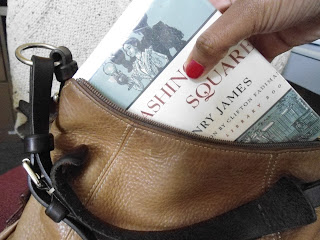
I love books that can fit into my purse!
My thoughts: I really liked this book, but it left me in a very sober mood. I read the Introduction of my copy, which was written by Clifton Fadiman. I mention this because I fell out of the habit of reading Introductions to novels when I read one that revealed a plot twist that I probably would not have predicted. I hate that. Anyway, one thing Fadiman wrote about Washington Square stuck with me—he wrote that “our literature was enriched by an acute study of a small segment of American culture.” That’s not only true about this novel, but also about The Living Is Easy.

The novel is set in pre-Civil War New York. It’s a New York before new money and robber barons invaded society and changed things forever. It’s an era, actually, before that of Edith Wharton’s The Custom of the Country. The novel is a very insular novel (in fact, it even seems as if most of the novel takes place indoors). There are only a handful of characters, but because of this we can focus intensely on them. Washington Square is the story of Catherine Sloper, a New York heiress of average looks and personality (that’s her main point, it seems). A pauper named Morris Townsend wants to marry her, and Catherine’s father, Dr. Sloper, thinks Morris is a golddigger. Dr. Sloper is absolutely right about Morris’s motives and character, but, as Fadiman points out, “to be right is not enough.”

Henry James uses first person a great deal—he writes “I,” “we,” and “our.” This really brings the reader into the story, and makes it seem as if James is sort of an old friend who’s telling us this interesting story. The conversational tone is constant (which makes me happy—constancy in using a literary device is a virtue). When Dr. Sloper wants to take Catherine to Europe in order to distract her from her, Henry James writes, “Catherine had many farewells to make, but with only two of them are we actively concerned.” There is something really endearing about that.

The psychology of the novel is fascinating to me. Dr. Sloper and Mrs. Penniman (Catherine’s aunt) pretty much stunt Catherine’s growth. Both are unlikable, but Dr. Sloper’s sarcasm is a little funny (but sad, ultimately, as it usually comes at the expense of his own child). He is an intriguing character, and his conversation with Morris Townsend provides some amazing dialogue from Henry James. Dr. Sloper wants to bend Catherine to his will, and is amused to discover that she has a will of her own. It’s hurtful that he has such a low opinion of his daughter (maybe this was common for fathers at this time…if so, that’s pretty unfortunate). And Mrs. Penniman is downright inappropriate…weird, truth be told. She wants the relationship between Morris and Catherine to be a great love story, and sticks her nose in where it certainly doesn’t belong in order meet this goal. She’s irritating, creepy, and crosses a lot of boundaries (if only therapy were around for our dear Catherine). Catherine, we are constantly told, is dull and unremarkable. But in the end I came to admire her. Mrs. Almond, Catherine’s other aunt, seems to be the lone person with common sense, but because she minds her own business, we don’t hear much from her corner.

Great passage: There was something hopeless and oppressive in having to argue with her father; but she too, on her side, must try to be clear. He was so quiet; he was not at all angry; and she, too, must be quiet. But her very effort to be quiet made her tremble.

Up next: I decided that I need more Henry James in my life, so I am going to pick up The Portrait of a Lady again—and finish it!

A quote on one of my tea bags by Henry James's brother William